Traffic is down. So someone opens the ad account.
Leads are down. Someone proposes a new landing page.
Sales are complaining. Someone suggests buying a list.
Suddenly, the entire organization is running faster in the wrong direction.
Marketing teams have a strange habit of treating every problem as a traffic problem. When pipeline dries up, the default reflex is usually to pour more money into the top of the funnel.
But if your lead generation system is broken, scaling it just means you fail louder, faster, and at a higher cost.
Before you launch another campaign or overhaul your CRM, you need to figure out where the system is actually breaking. You need to stop fixing metrics and start diagnosing the system.
1. The “Don’t Jump to the Fix” Principle
In marketing, symptoms are dangerously deceptive.
A low lead volume does not automatically mean you have a traffic problem. A high lead volume does not automatically mean marketing is succeeding. And a high landing page conversion rate does not mean your funnel is healthy.
If you treat the symptom without finding the root cause, you usually create a new bottleneck further down the line.
To fix a growth engine, you have to separate the symptom from the cause using corroborating evidence.
2. The Lead-Gen System as an Interlocking Chain
We like to draw marketing funnels as neat, linear triangles.
Awareness, consideration, decision.
The reality of B2B buying is much messier. Research from Gartner on the B2B buying journey illustrates a complex, non-linear process—often described visually as a complex maze or web.
Buyers loop back and forth between identifying problems, exploring solutions, and building internal consensus among multiple stakeholders.
Because the buyer’s journey is a web, your lead generation system is an interlocking chain.
Traffic generation, user experience, offer positioning, marketing automation, and sales follow-up all rely on each other.
A break in one link invalidates the rest.
3. The Strategist’s Diagnostic Framework
To figure out which link is broken, you cannot look at a single metric.
An isolated metric is just a signal.
You have to look at the intersection of metrics to rule out competing explanations.
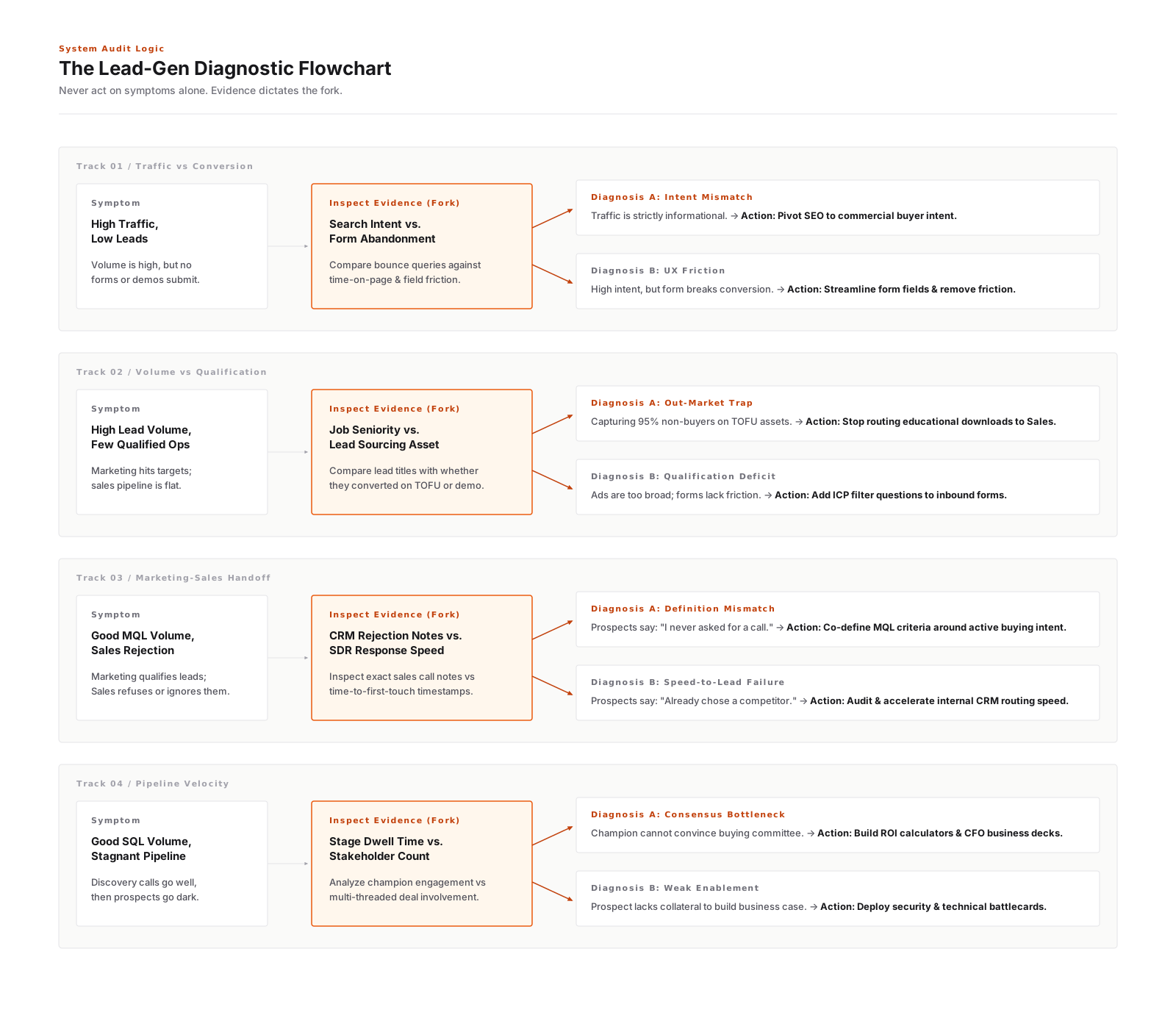
The core logic of a strategist’s audit looks like this:
Let’s apply this to the four most common B2B lead generation bottlenecks.
4. Major Symptoms and Competing Root Causes
A. High Traffic + Low Lead Volume
The Symptom: Thousands of people are visiting your core pages, but nobody is filling out a form or requesting a demo.
The Evidence to Inspect:
Search query intent in Google Search Console, session recordings, page dwell time, and form abandonment rates.
Competing Causes:
-
Intent Mismatch: You are attracting an audience that isn’t looking for a commercial solution.
-
UX Friction: You have the right buyers, but your conversion mechanism is actively repelling them.
How Evidence Changes the Diagnosis:
Imagine two companies with the exact same symptom: high traffic, low leads.
-
Company A looks at their data and sees a high bounce rate. Their top organic keyword is highly informational, bringing in students researching the industry, not buyers. Their diagnosis: Intent Mismatch.
-
Company B sees high time-on-page and heavy traffic to the pricing page, but users drop off exactly when they click the “Request Demo” form. Their diagnosis: UX Friction.
The Action:
If the intent is wrong, rewrite your content to target commercial intent over sheer volume.
If friction is the problem, test frictionless conversions—only reduce form fields if you have confirmed that the form length is the actual barrier.
B. High Lead Volume + Few Qualified Opportunities
The Symptom: Marketing is celebrating record-breaking lead volume. Sales is frustrated because pipeline is totally stagnant.
The Evidence to Inspect:
Lead job titles, company sizes, the specific campaign that sourced the lead, and CRM rejection notes.
Competing Causes:
- The Out-Market Trap: Research from the Ehrenberg-Bass Institute suggests a useful heuristic: because B2B buying cycles are long, roughly 95% of an addressable market is not actively buying at any given time.
If you gate top-of-funnel educational content, you capture contact info from people who are consuming educational content but lack immediate purchase intent.
- Zero Qualification Friction: Your ads are too broad and your forms are too easy, letting in unqualified small businesses or junk data.
How Evidence Changes the Diagnosis:
-
Company C generates 500 leads a month from an ebook download. The leads are senior executives, but they refuse sales calls because they were just doing early-stage research. Diagnosis: Out-Market Trap.
-
Company D generates 500 leads a month from a “Talk to Sales” page, but the leads are primarily college interns and mom-and-pop shops that don’t fit the Ideal Customer Profile (ICP). Diagnosis: Zero Qualification Friction.
The Action:
If lead quality is the problem, deliberately introduce friction.
Add a qualifying question on your form to filter out noise.
If out-market buyers are the issue, stop passing educational content downloads directly to the sales team as “hot leads.”
C. Good MQL Volume + Poor Sales Acceptance
The Symptom: Marketing qualifies a lead (MQL) and passes it over. Sales rejects it or ignores it.
The Evidence to Inspect:
Sales rejection reasons in the CRM, SDR follow-up time (speed-to-lead), and the historical definition of an MQL.
Competing Causes:
-
Definition Mismatch: Marketing’s lead scoring system assigns points for minor actions (like attending a webinar) and calls them “qualified.”
-
Speed-to-Lead Failure: The leads are actually high-intent, but by the time sales calls them three days later, the prospect has already spoken to a competitor.
The Action:
Do not assume sales is lazy, and do not assume marketing’s leads are garbage.
Pull the call recordings.
If the prospect says “I never requested a call,” you have a definition mismatch.
Force a revenue-team meeting to co-define an MQL based on active buying intent.
If the prospect says “we already went with someone else,” audit your internal lead routing speed.
D. Good SQL Volume + Stagnant Pipeline
The Symptom: Sales Qualified Leads (SQLs) are high. The initial discovery calls go incredibly well. Then, the prospect goes dark.
The Evidence to Inspect:
Average time-in-stage in your CRM, win/loss notes, and the number of stakeholders attached to the deal.
Competing Causes:
-
The Consensus Bottleneck: The person you are talking to loves the product, but they can’t convince their CFO to sign off.
-
Weak Enablement: The prospect doesn’t have the materials they need to build an internal business case.
The Action:
Build mid-funnel sales enablement materials—ROI calculators, technical battlecards, security one-pagers—to help your champion sell the product when you aren’t in the room.
5. When Two Diagnoses Look Plausible
Sometimes, the CRM data is ambiguous.
You might have high form abandonment and questionable search intent.
When two diagnoses look plausible, a strategist looks for the tie-breaker metric.
This usually requires leaving the quantitative dashboard and looking at qualitative data.
Listen to five recorded sales calls.
Read support tickets.
Talk to the SDRs who actually have to dial the leads you generate.
Marketing analytics tell you what people clicked; qualitative feedback tells you why they didn’t buy.
If the data is split, trust the conversations happening closest to the revenue.
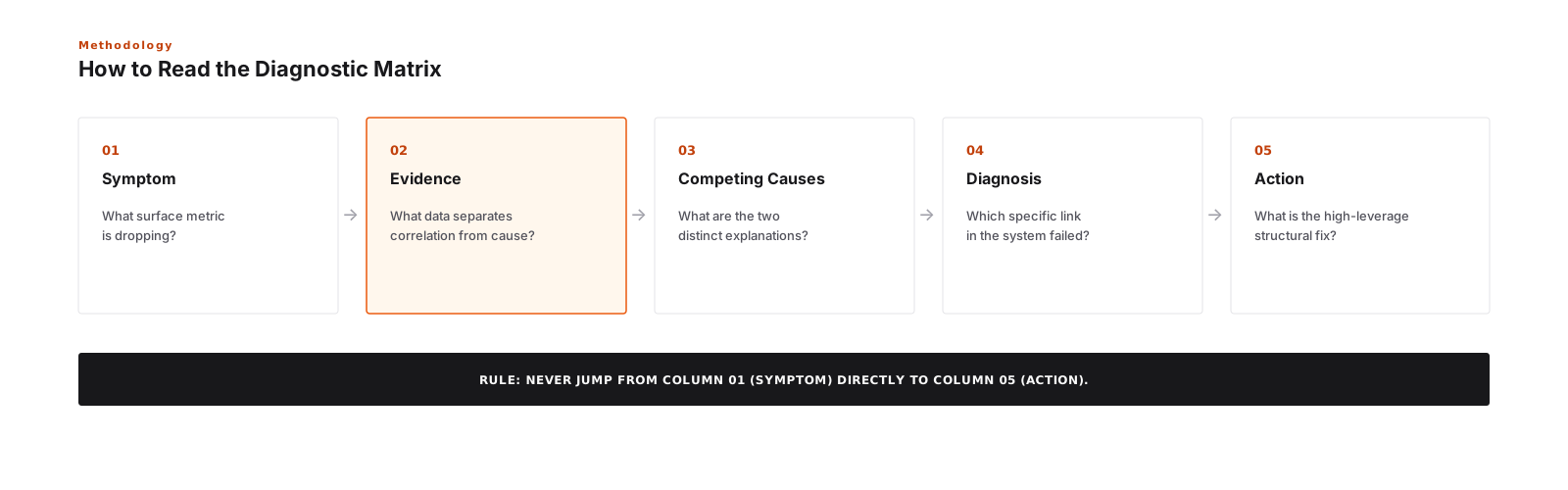
6. The Diagnostic Matrix
Use this matrix to audit your own system.
| Symptom | Evidence to inspect | Competing causes | Possible diagnosis | Strategist's action |
|---|---|---|---|---|
| High Traffic, Low Leads | Search intent, session heatmaps, form drop-offs | 1. Irrelevant traffic 2. Conversion friction |
Intent Mismatch or UX Friction | Align page copy with intent. Test friction reduction on forms if drop-offs are verified. |
| High Leads, Low Quality | Job titles, lead source campaign, time on site | 1. Capturing out-market researchers 2. Broad targeting |
Out-Market Trap or Qualification Deficit | Add qualifying questions to high-intent forms. Separate content leads from sales leads. |
| Good MQLs, Sales Rejects | CRM rejection notes, SDR response time, MQL criteria | 1. Scoring minor activity too highly 2. Slow follow-up |
Definition Mismatch or Speed-to-Lead Failure | Co-define MQLs with sales based on buying intent. Audit CRM routing rules. |
| Good SQLs, Stagnant Pipeline | CRM time-in-stage, stakeholders per deal | 1. Lack of internal consensus 2. Weak business case |
Consensus Bottleneck | Supply mid-funnel enablement (ROI tools, technical specs) to help champions sell internally. |
7. Triage: How to Prioritize the Fix
If you run this audit and realize your B2B lead generation system is broken in multiple places, do not try to fix everything at once.
Apply the strategist’s rule of triage:
Work backward from revenue.
Always fix bottom-of-funnel leaks before you pour more traffic into the top.
If your sales team is dropping high-intent demo requests because of a broken CRM routing rule, fix that today.
There is zero point in scaling SEO if the bottom of your funnel is a sieve.
Fix the pipeline.
Fix the handoff.
Fix the lead quality.
Then scale the traffic.
8. Conclusion: Growth Requires Systems Thinking
Lead generation is not a collection of isolated hacks.
You cannot solve a complex B2B sales cycle simply by changing the CTA on a landing page.
When metrics fall, the instinct is to execute faster.
But execution without diagnosis is just organized panic.
The next time you face a bottleneck, don’t rush to fix the metric.
Take a step back, look at the corroborating evidence, and diagnose the system.