An idea strikes. It’s brilliant.
Within 48 hours, you have purchased a domain name. You’re designing a logo. You are looking at Shopify themes, debating color palettes, and researching packaging suppliers. You’re already thinking about the Instagram aesthetic and wondering which micro-influencers you should reach out to.
The momentum feels incredible. You are building a brand.
But amidst the excitement of fonts and unboxing experiences, nobody has stopped to ask the most uncomfortable question in business:
What actual evidence do we have that strangers will pay for this?
Every year, thousands of Direct-to-Consumer (D2C) founders launch physical products based entirely on a gut feeling. They follow a predictable, deeply ingrained conventional launch sequence:
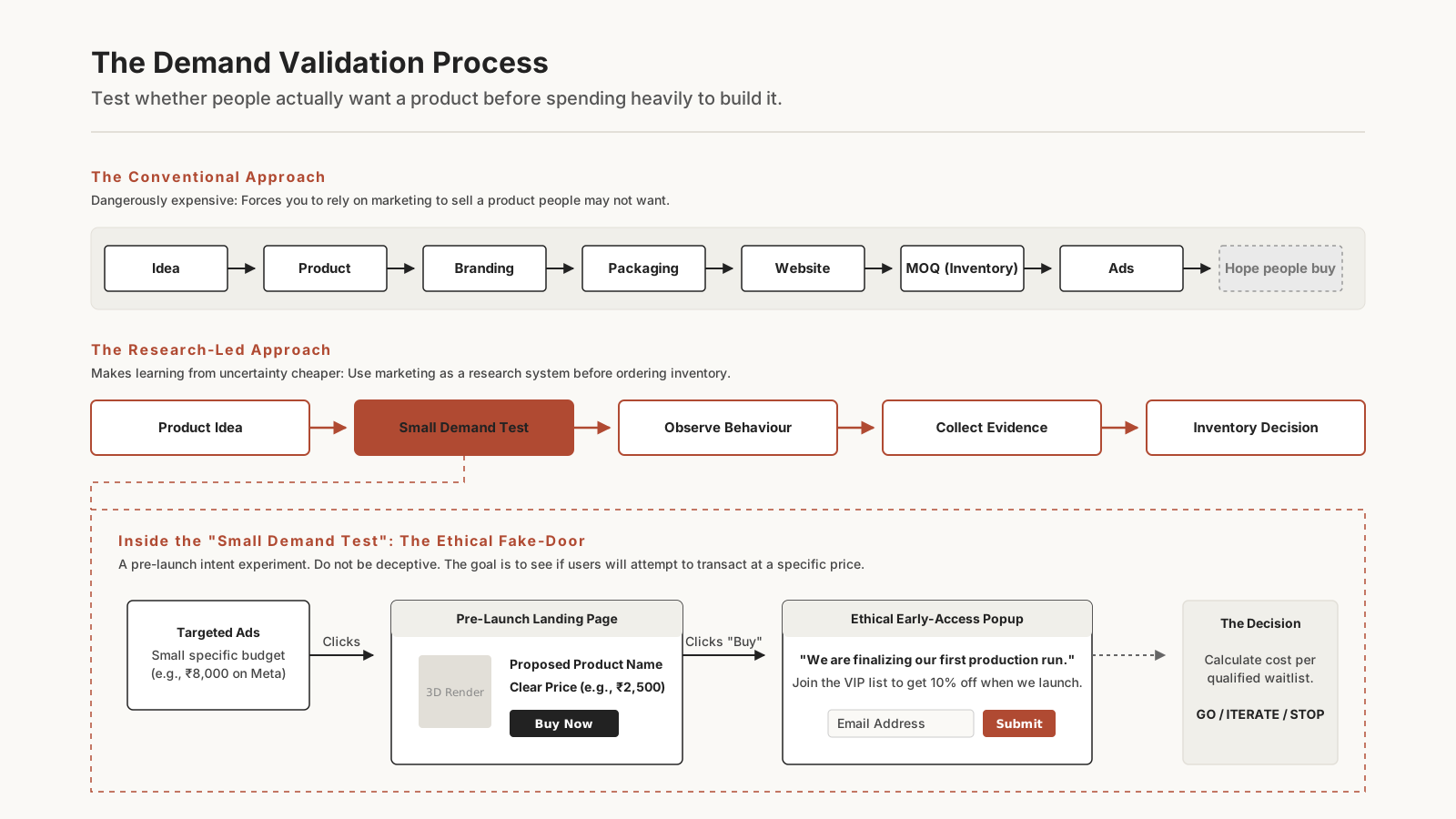
Idea → Product → Branding → Packaging → Website → MOQ (Minimum Order Quantity) → Ads → Hope people buy.
This sequence feels logical because it is how we are taught businesses are built. First you make the thing, then you market the thing.
But it is also dangerously expensive. If you are wrong about what people want, you don’t find out until you have a garage full of unsold inventory and a maxed-out credit card. You end up trying to use marketing to force people to buy a product they never asked for.
Good marketing starts with better decisions. And better decisions start with better evidence.
Before you spend serious money manufacturing a product, marketing should not be a promotional tool. It should be a research system. The goal isn’t to completely eliminate uncertainty—entrepreneurship always involves risk. The goal is simply to make learning from uncertainty much cheaper.
Here is how a strategist tests D2C demand before ordering inventory.
Separating Interest from Demand
Validation is not asking your friends if they like your idea. Your friends are excellent at supporting you; they are terrible at being your market research department.
Validation is also not getting 500 likes on an Instagram concept post.
Demand validation is the process of presenting your proposed solution to a stranger and asking them to give up something of value—their time, their email address, or their money—to get it.
To find commercial truth, you have to separate “interest” from “demand.” Curiosity is free. Demand requires friction.
The Evidence Ladder
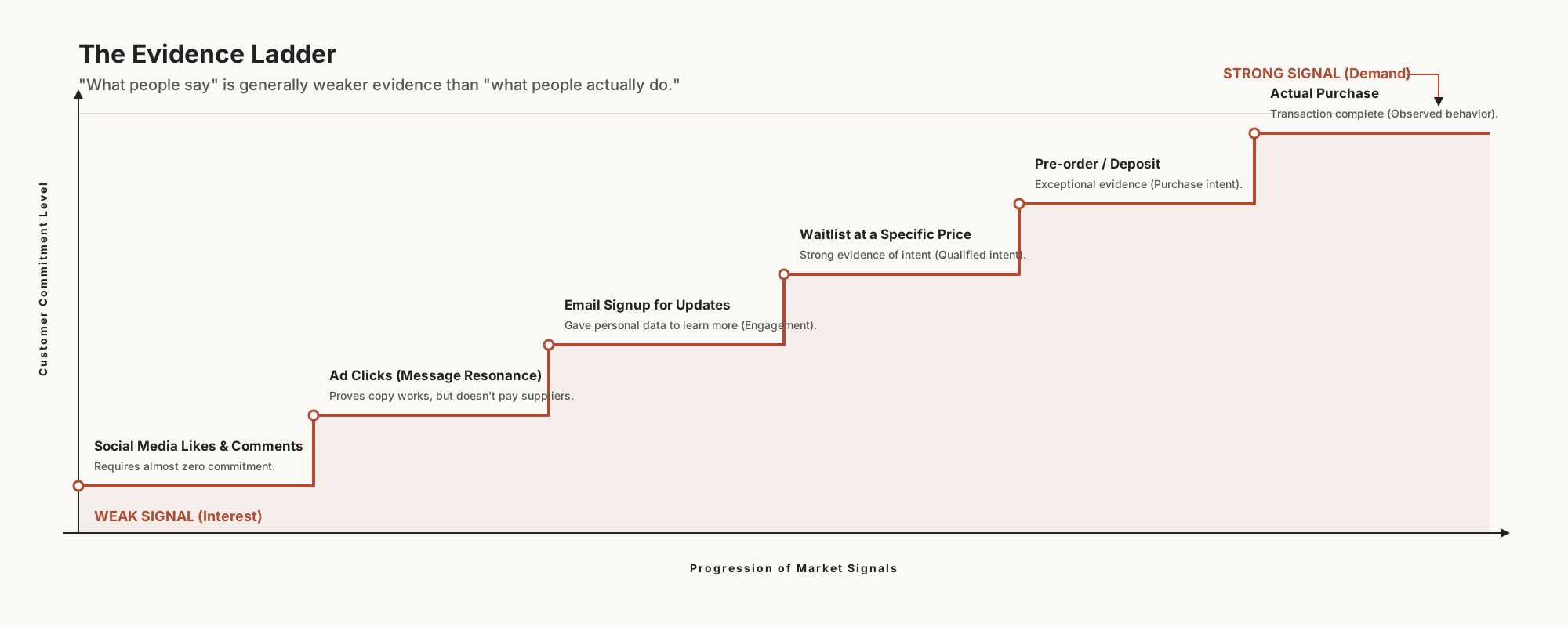
When you test a product idea, you will receive different signals from the market. A strategist evaluates these signals based on the level of customer commitment required. Think of it as a ladder:
- Social Media Likes & Comments: A like can indicate attention or aesthetic resonance, but it is a weak commercial signal because it requires almost zero commitment.
- Ad Clicks (Message Resonance): The user was interested enough to pause their scrolling and click. This proves your ad copy works, but clicks don’t pay suppliers.
- Email Signup for Updates (Engagement): The user gave you a piece of personal data to learn more. This is decent early evidence that you have struck a nerve.
- Waitlist at a Specific Price (Qualified Intent): The user saw the price of your product and still gave you their email to be notified when it launches. This is strong evidence of intent.
- Pre-order / Deposit (Purchase Intent): The user handed over their credit card details for a product that doesn’t exist yet. This is exceptional evidence of demand.
- Actual Purchase (Observed Behavior): The product is live, the transaction is complete, and the customer didn’t ask for a refund.
You don’t need to reach the top of the ladder on day one. But you do need to stop confusing the bottom of the ladder for proof of a viable business.
The Strategist’s Toolkit: 5 Ways to Gather Evidence
How do you get this evidence without spending a fortune? You run cheap, isolated experiments. Here are the primary methods, what they prove, and what they don’t.
1. Search Demand Analysis
If you are selling a solution to a known problem (like a “back posture corrector”), your first step is checking if anyone is actively looking for it. Using tools like Google Keyword Planner or Google Trends, you can indicate whether people are actively searching for the problem or category. However, keep in mind that search volume does not prove willingness to pay.
- What it proves: Problem awareness. It shows people are actively frustrated and looking for a fix.
- What it DOESN’T prove: Willingness to pay for your specific brand or solution.
- Note: If you are inventing a completely novel product category, search volume will be zero. That doesn’t mean the idea is bad; it just means you need a different test.
2. Customer Interviews (The “Mom Test” Principle)
If you ask someone, “Would you pay ₹2,000 for this skincare serum?” they will often say yes just to be polite. As entrepreneur Rob Fitzpatrick explains in The Mom Test, humans are terrible at predicting their own future behavior.
- What it proves: Context. It tells you what frustrations people have and the exact vocabulary they use to describe them.
- What it DOESN’T prove: Future buying behavior.
- How to use it: Don’t ask about the future. Ask about the past. “What serums have you bought in the last six months? Why didn’t you like them? How much did they cost?” Past behavior is the best predictor of future intent.
3. The Ethical “Fake Door” Test
In this context, we are using the term “fake door” to describe a pre-launch intent experiment, NOT deceptive checkout behavior. It involves building a landing page for a product before it is manufactured. You run a small amount of paid traffic to it. You clearly display the product, the positioning, and the exact price. When the user clicks “Buy Now,” an ethical early access or coming soon popup appears: “We are finalizing our first production run. Join the VIP early-access list to get 10% off when we launch.”
- What it proves: Will people attempt to transact when presented with a specific product and price point?
- What it DOESN’T prove: It doesn’t prove 100% of those people would have actually completed the checkout process.
- Real-world context: Before Joel Gascoigne built the social media app Buffer, he tested a landing page that included a pricing table. Only when users actually clicked on the paid tiers did he ask for an email, giving him the confidence to start writing code.
4. The Pre-Order / Deposit Test
You tell the customer upfront: “This product is currently in manufacturing. Pre-order now to secure yours for delivery in 60 days.”
- What it proves: Exceptionally strong purchase intent.
- What it DOESN’T prove: That your entire business model works. Even an actual purchase or pre-order still does not answer questions about repeat purchase, profitability, retention, or long-term viability.
5. The Concierge / Manual MVP Approach
A Minimum Viable Product (MVP) is the absolute simplest version of your idea that solves the customer’s problem.
- Real-world context: Before Zappos became a massive online shoe retailer, founder Nick Swinmurn didn’t buy a warehouse full of inventory. He took photos of shoes at local stores and put them online. When someone bought a pair, he went back to the store, bought them at retail price, and shipped them manually. He lost money on the margins, but he definitively proved a critical assumption: people were willing to buy shoes on the internet.
The Practical Validation Framework
You don’t need a marketing agency to validate demand. You just need a hypothesis, a landing page, and a small ad budget.
If you are a founder about to place an inventory order, run this framework first.
1. The Hypothesis: Write down exactly what you believe. Example: Millennial office workers will pay ₹2,500 for a desktop blue-light therapy lamp.
2. The Target Customer: Who exactly are you testing? Example: 25–35-year-olds working remotely, targeted via Meta ads.
3. The Problem & Offer: What is the specific deal? Example: A sleek, modern lamp that reduces eye strain, priced clearly at ₹2,500.
4. The Experiment (The Fake Door): Use a simple landing page builder. Put high-quality 3D renders or prototype photos of the product. Clearly display the ₹2,500 price. Add the “Buy Now” button that leads to an ethical early-access waitlist form.
5. The Success Criteria (Do this BEFORE you test): This is where most founders fail. They run a test, get mediocre results, and then move the goalposts to justify proceeding anyway. Define your kill criteria based on your unit economics.
If your lamp sells for ₹2,500 and costs ₹1,000 to manufacture, your gross margin is ₹1,500. If you need ₹500 in profit, your absolute maximum allowable Customer Acquisition Cost (CAC) is ₹1,000.
Therefore, your hypothetical rule for this specific product might be: “If I cannot get a qualified waitlist email for under ₹300, I will not order inventory, because my eventual CAC will be too high.” This ₹300 is just an illustrative example, not an industry benchmark; your threshold will depend entirely on your own margins.
6. The Traffic: Allocate a strict, illustrative budget—for example, ₹8,000—on Meta ads driving targeted traffic to that exact page.
7. The Evidence & Decision: Look strictly at your Waitlist Conversion Rate. Then, make your choice:
- GO: Evidence is strong. Your cost per waitlist is low. Proceed to manufacturing.
- ITERATE: You got traffic but no waitlists. The signal exists, but the price might be too high or the audience too broad. Adjust and test again.
- STOP: The ads are ignored. The page converts at 0%. The evidence does not justify the investment. Stop the project.
If the test fails, you haven’t failed. You successfully purchased highly valuable data that saved you from a massive financial mistake.
A Tale of Two Founders (Hypothetical Scenario)
Let’s look at how this plays out in the real world. Imagine two founders who both want to launch a premium matcha-infused face mask called “Lumière,” priced at ₹3,000.
Founder A takes the Conventional Route. She spends ₹1,50,000 on branding and web design. She orders the factory MOQ of 1,000 units for ₹4,00,000. She launches and spends ₹50,000 on Facebook ads. People visit the site, but almost nobody buys. She eventually realizes that the market for premium face masks is heavily saturated, and customers don’t trust an unknown brand enough to spend ₹3,000. She has spent ₹6,00,000 to learn that her pricing model is flawed. Her capital is now trapped in boxes in her living room.
Founder B takes the Research-Led Route. She spends ₹2,000 on a landing page builder and uses a high-quality mockup of a jar. She sets the price at ₹3,000 and runs a ₹10,000 ad campaign to test the offer. She gets 300 visitors, but only 2 people click to join the waitlist. Her cost per intent is astronomical. Instead of giving up, she clones the landing page. She pivots the branding, positions it as an “Everyday Matcha Mask,” and drops the price to ₹1,200. She runs another ₹10,000 ad test. This time, 45 people join the waitlist. She realizes the market doesn’t want another luxury brand; they want an affordable daily utility. She calculates her margins at the ₹1,200 price point. Then, and only then, she calls the manufacturer to negotiate her first inventory order.
Founder B spent ₹22,000 to figure out exactly what the market wanted before committing to the factory.
Conclusion: Make Uncertainty Cheaper
You don’t need another moodboard. You need evidence.
When you have a new product idea, the instinct is to build it as fast as possible. But executing quickly on a flawed assumption is just organized panic.
The next time you are staring at a massive quote from a manufacturer, pause. Ask yourself what evidence you actually have that strangers will open their wallets.
Run a cheap experiment. Listen to the data. Good marketing doesn’t force people to buy what you already built; it figures out what people want before you build it.